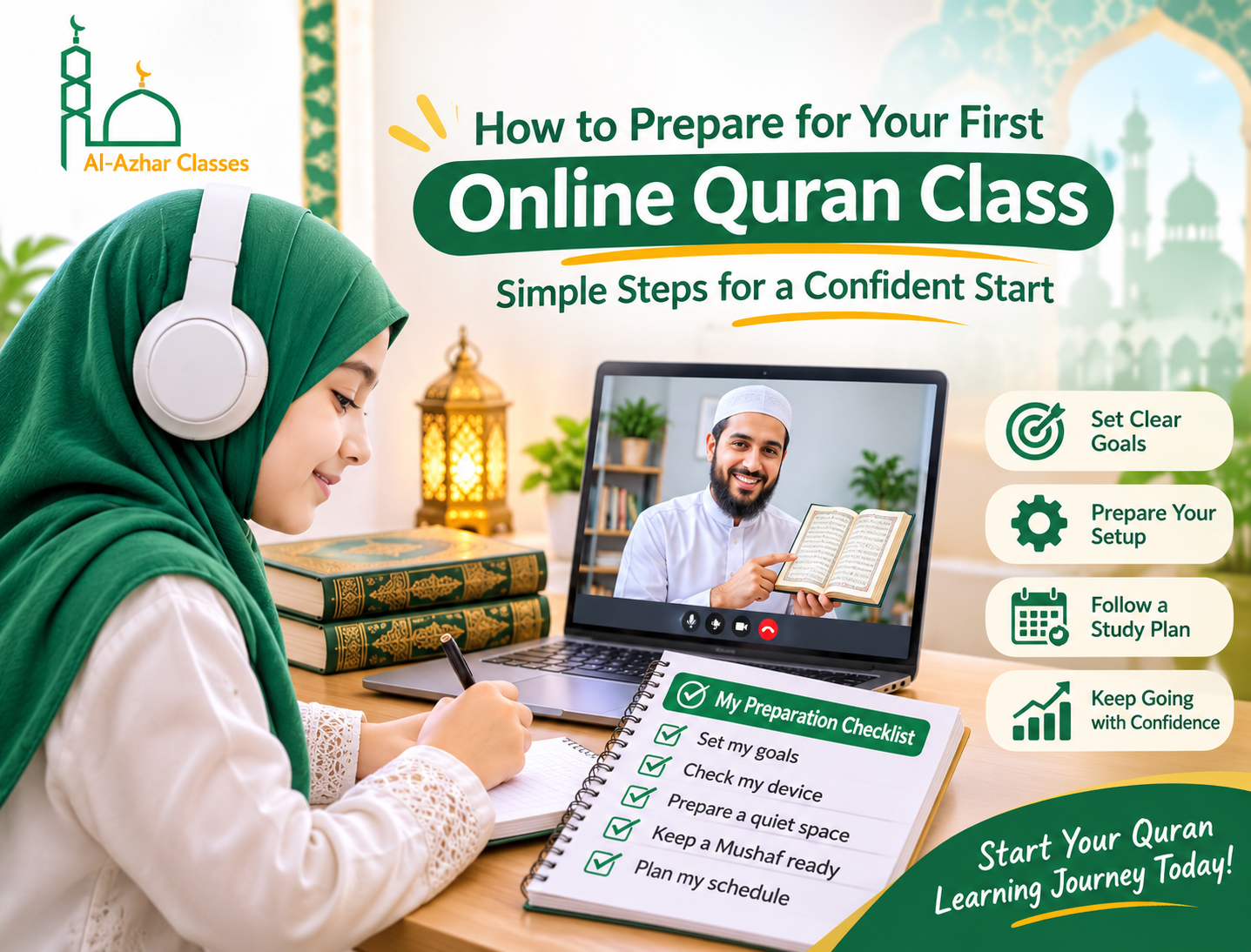

Starting to read the Quran with a teacher is exciting, and a little nervousness before the first session is normal. Most of that worry comes from not knowing what will happen on screen. Good online Quran lesson preparation removes much of the uncertainty, because it turns an unfamiliar hour into a handful of small tasks you can finish in advance. This guide covers what to decide, what to set up, what the first lesson usually looks like, and how to keep going afterward. The advice reflects how structured one-to-one teaching, including the lessons offered by Al Azhar Classes, normally works.
Why preparation matters more than most beginners expect
Pew Research Center estimated that there were about 1.9 billion Muslims in 2020, and most of them do not speak Arabic as a first language. That means many learners meet the Arabic letters for the first time as teenagers or adults, so a first lesson is often spent on sounds rather than surahs. The Quran has 114 surahs in 30 parts, while the Arabic alphabet has 28 letters, so the starting point is smaller than it looks from the outside.
Learning with a teacher also has deep roots. The Prophet Muhammad ﷺ said, “The best of you are those who learn the Quran and teach it” (Sahih al-Bukhari 5027).
Video lessons with a private tutor have become a regular option for families spread across time zones. Al Azhar Classes teaches students in many countries, as this overview of live lessons for global students explains. The format is convenient, but it puts more responsibility on the student to arrive ready. Lesson minutes go to recitation when the microphone already works.
See also: How Window Upgrades Influence Everyday Living Beyond Energy Savings
Decide what you want from the lessons
A teacher can only plan a course if they know where you want to end up. Write down your Quran learning goals in plain words before the first call. Common examples include:
- Reading the Quran fluently from the page, starting with the letters
- Correcting pronunciation with Tajweed rules
- Memorizing short surahs from Juz Amma, the 30th part
- Helping a child build a steady recitation habit
- Working toward an Ijazah once Tajweed is strong
Pick one goal for the first three months and one for the first year. Be honest about your level too. Saying “I cannot read Arabic yet” helps a teacher far more than pretending you can, and it saves weeks of mismatched material.
Choose a teacher and a format with care
Not every tutor suits every beginner. Ask about training in recitation, experience with new learners, and whether lessons are one-to-one or in a group. Al Azhar Classes states that its teachers pass an identity and education check and take part in regular assessments, which is the kind of detail worth asking any provider about.
Before you commit, bring a short list of questions:
- Does the teacher hold formal training or an Ijazah in recitation?
- Will you get private feedback, or share the time with others?
- How is progress recorded and shared?
- What happens if you must reschedule?
If you want to learn Quran online with a live teacher, a trial lesson lets you judge teaching style before you pay for a package. After you start, read how to get the most out of your Quran tutor, since small habits in the first weeks shape the rest.
Prepare your space and your device
Technical trouble is the most avoidable problem in a first lesson. A day earlier, run through this checklist:
- Test the video app your teacher uses, such as Zoom or Skype, and update it
- Use headphones with a microphone so your recitation is clear
- Choose a quiet corner with good light and a device at eye level
- Keep a phone hotspot ready in case your connection drops
- Have a printed mushaf in the script your teacher uses, plus a notebook and pen
- Make wudu before you join, since most scholars advise it before touching the printed mushaf
Respectful surroundings help too. Switch off notifications and tell your household that you will be unavailable for the session.
Learn a few basics beforehand
You do not need to master anything before lesson one, but ten minutes of exposure helps. Say the names of the 28 Arabic letters slowly, look at how a letter changes shape at the start, middle, and end of a word, and listen to Surah Al-Fatiha, which has seven verses, two or three times. Notice which sounds feel difficult. Letters such as ع, ح, and ق have no close equivalent in English and many other languages, so beginners often need extra time with where each sound is formed in the mouth and throat. Tell your teacher what you noticed.
Spaced listening works better than one long session. A widely cited 2006 review by Cepeda and colleagues found that spreading study across several sessions improves retention compared with cramming. Short daily exposure fits that finding.
What happens during the first lesson
Formats differ, but many first sessions run 30 to 45 minutes and follow a similar order:
- A greeting and a short conversation about your background
- A quick check of your reading level
- A discussion of your goals and a suggested plan
- Practice with letter sounds or a short passage
- Homework and the next lesson time
Expect to be corrected. Teachers hear pronunciation details that beginners cannot hear themselves, and correction is the service you are paying for. The Prophet ﷺ also said that the one who recites with difficulty, stammering through it, receives a double reward (Sahih al-Bukhari 4937 and Sahih Muslim 798).
Common challenges and how to handle them
- Embarrassment about mistakes is the most common barrier: Treat each correction as progress, because mistakes show the teacher what to teach next.
- Time zones can make scheduling awkward: Pick a slot you can keep every week and ask about flexibility. Al Azhar Classes says its tutors are available around the clock.
- Slow early progress frustrates many adults: Letter shapes and sounds can take several weeks to settle, and consistent learning matters more than speed.
- Busy days push practice aside: Anyone who wants to study the Quran regularly around a full schedule can use short blocks, such as ten minutes after Fajr.
- Younger students lose focus faster: Parents will find this guide for parents useful, and sitting beside a child for the first few sessions helps.
Build a routine after the first session
Preparation does not end when the call does. Treat online Quran lesson preparation as a weekly habit:
- Review your notes within a day, while the corrections are fresh
- Record yourself reciting and compare it with your teacher’s recitation
- Practice for 10 to 15 minutes a day instead of one long weekend session
- Follow a plan for Tajweed practice at home between lessons
- Check your Quran learning goals every month and adjust them with your teacher
Sounds that feel impossible in week one often become routine within a few months of steady practice.
Frequently Asked Questions (FAQs)
1. How do I prepare for my first Quran lesson with a tutor?
Test your video app and microphone a day before. Keep a printed mushaf, a notebook, and a pen ready, and make wudu before you join. Good online Quran lesson preparation also means learning the names of a few Arabic letters and writing down your Quran learning goals so your teacher can plan around them.
2. What should I look for when choosing a Quran teacher for beginners?
Look for formal recitation training, experience with new learners, and a clear way of tracking progress. Al Azhar Classes states that its teachers pass identity and education checks and take part in regular assessments. You can read more about its certified Quran teachers before booking a trial lesson.
3. Do I need to know Arabic before I start?
No. Many beginners start with the 28 letters and their sounds, then move to short passages. If you want to understand the language of the text later, this Quranic Arabic guide explains how to begin.
4. How long does it take to read the Quran with Tajweed?
It depends on your starting level, how often you practice, and how much feedback you receive. Daily practice of 10 to 15 minutes helps most learners. For a sample timeline, see this Tajweed learning plan for six months, and ask your teacher to adjust it to your pace.
5. Is Tajweed required for beginners?
Tajweed is the set of rules for pronouncing the letters correctly, and teachers usually introduce it from the first lessons so that habits form correctly. This article on whether Tajweed is compulsory covers the scholarly discussion in more detail.
6. Can children start learning the Quran from home?
Yes. Younger students do best with short sessions, a quiet space, and a parent nearby for the first few lessons. These easy Quran lessons for kids show how a child-friendly routine can work at different ages.
7. How can I fit lessons into a busy schedule?
Choose a fixed weekly slot and ask about rescheduling before you commit. Al Azhar Classes says its tutors are available around the clock, which helps across time zones. This post on Quran courses for busy professionals describes how flexible timing works in practice.
Final thoughts
A first lesson goes better when you know your goals, have tested your equipment, and have met a few letters in advance. Al Azhar Classes offers one-to-one lessons in Quran reading, Tajweed, memorization, and Arabic, and its registration form leads to a first lesson arranged by the team. With a prepared space and a clear plan, you can spend that first hour reciting.